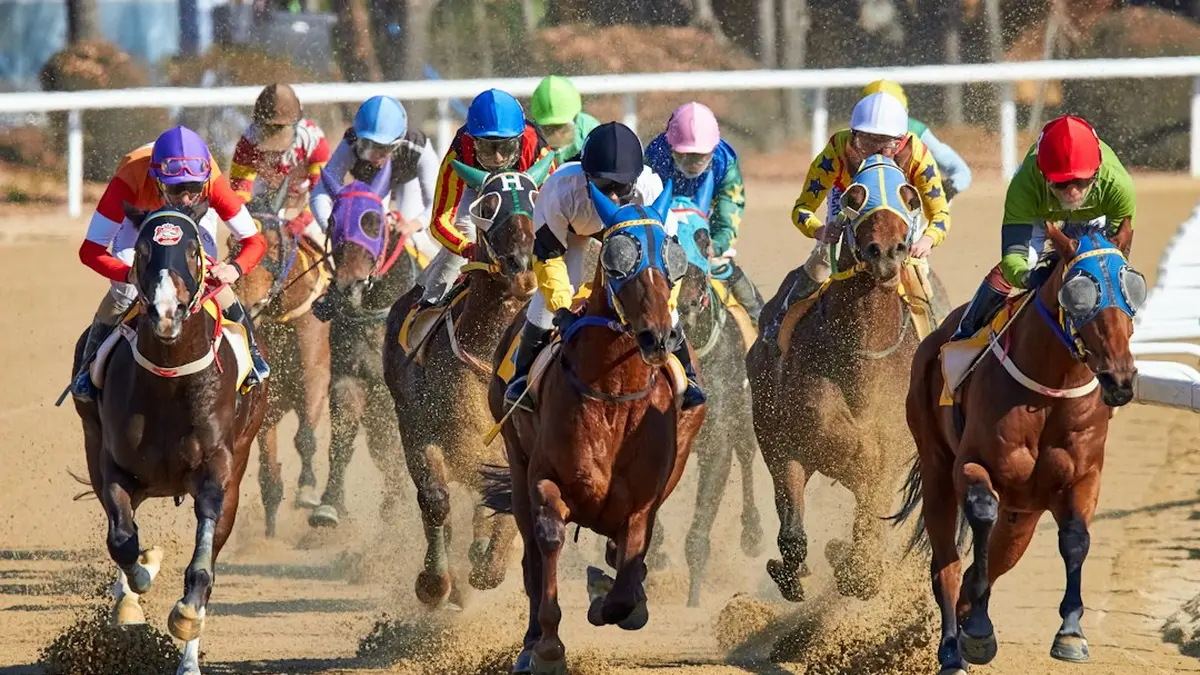
On September 12 at Churchill Downs, a two-year-old named Bearamour ran the opening quarter-mile of the Iroquois Stakes in :22.85. Pace handicapping is the work of knowing, before the gate opens, what a number like that will do to every horse in the race.
Pace handicapping means judging whether a race will be run fast or slow in its early stages, then using that judgment to decide which running styles can win. You meet it in the fractional times printed in every past performance line, in the early and late pace figures sold by the Daily Racing Form and Brisnet, including the TimeformUS figures now sold only through DRF.com, and in every preview that calls a horse "lone speed." It decides whether you trust a favorite who needs the lead, and whether a horse who has always come from behind has a real chance today.
The Iroquois shows how much rides on it. Bearamour went a half-mile in :46.35 with He Is No Lie pressing him from second. Salahudin, the Bob Baffert-trained favorite, broke slowly from post 5 and trailed most of the field. He circled four wide on the far turn and caught He Is No Lie in midstretch, according to the Churchill Downs recap. "Down the stretch I thought I could get the job done," said Joel Rosario, who rode He Is No Lie, "but (Salahudin) kept coming at us."
The lesson of that race is the argument of this page. Races are often decided less by which horse is fastest than by which horse is spared the cost of being fast early. A horse who has to answer a rival through the first half-mile pays for it in the stretch, and a horse who sat and watched does not.
Fractions, figures and the shape of a race
The method starts with the fractions, the leader's times at each point of call. On their own they mislead. A :46.35 half-mile means one thing in a one-mile route and something else in a six-furlong sprint, and it means something else again on a sloppy track. Pace figures exist to translate raw time into a number that can be compared.
The figure-makers do this in slightly different ways. Randy Moss Pace Figures, formerly published by the Daily Racing Form, took as their baseline the average fractions of horses who earn Beyer Speed Figures between 80 and 89. They also scaled each length of margin by distance: a length was worth 3.3 points at two furlongs, 1.6 at four, 1.0 at six and 0.75 at a mile, because a length lost early costs more than a length lost late. DRF's past performances now carry TimeformUS Early and Late Speed Ratings instead, which rate early and late pace on their own scale, not the Moss baseline. Brisnet uses a flat two points per length and reports three numbers. E1 runs to the first call, which is two furlongs in a sprint and four in a route. E2 runs to the second call. LP measures from the pre-stretch call to the wire. A wide gap between a horse's E1 or E2 and its LP marks a horse likely to fade under pressure.
Next you count the speed. The NYRA Bets handicapping primer sorts races into "hot" and "cold" by how many probable pace-setters are entered, and it sums the idea in four words: "Pace makes the race." A field with one front-runner usually lets that horse control the tempo. With two, an honest duel usually ends with one of them giving way. With three or more, a meltdown becomes likely, and that is the race closers need.
The last step is to match running styles to the projected shape. Favor horses in midpack or farther back when the early pace looks fast and contested, and favor the front-runner when the field is short of speed. The national numbers explain why the second half of that rule matters so much. By one analyst's figures, horses who lead all the way carry an Impact Value of 180 and win 15 to 25% of the time, while backmarkers sit at 30 and win 3 to 8%. Early speed wins by default. Pace handicapping is how you spot the races where the default breaks down. It sits alongside speed, class and form and does not replace them.
Where it showed up this September
The Iroquois preview on the official Derby site projected He Is No Lie as "the quickest horse in the field and could be on the front for a long time if he clears the cast early." He did not clear them. Bearamour took the lead, He Is No Lie had to press, and the lone-speed scenario turned into a contested one. The Iroquois pace collapse followed from exactly that change.
Six days earlier, the Grade 1 Hopeful at Saratoga presented the opposite question. Booked had led all the way to win the Grade 3 Sanford by six lengths and then regressed. The America's Best Racing preview treated that win with caution, asking whether an unpressured lead had flattered him. It picked Midnight Still, who had "relaxed as many as four lengths off the lead" in his debut, because a closer would benefit if the pace up front got contested. The facts here do not include the Hopeful result, so it stands as an example of the projection and not of its outcome.
The third case shows up in the charts afterward. The Daily Racing Form's race shape symbols flagged a race "Favored Closers" or "Favored Speed," and only when the pre-race projection and the actual running agreed, but they came with the Moss Pace Figures, which DRF no longer publishes. The closest live equivalent is the TimeformUS Early and Late Speed Ratings in DRF's past performances, which rate early and late pace but do not flag the race shape, so you have to make that call yourself. A front-runner who won a race that favored closers held on through real pressure, and he earns an upgrade.
Not a speed figure
| What it tells you | What it misses | |
|---|---|---|
| Pace handicapping | How fast the early and middle stages will be run, and which running styles that shape helps | How good each horse is over the full trip |
| Speed figure | One number for the whole race, based on final time | Whether that time came off an easy lead or through a duel |
| Track bias | Whether the surface itself favors speed, closers or a path | How the particular field in today's race will set up |
I checked the section and found nothing out of date, so it's unchanged:
The two work together. A sealed dirt track tends to help speed and a muddy one tends to tire it, which is why a track bias read can change a pace projection without replacing it.
Before the next prep
Count the probable speed in the field before you look at anything else. If the favorite's best race came alone on the lead, ask who will go with him today. If a closer's figures look flat, check whether his races were slowly run. TimeformUS subscriptions are now sold only through Daily Racing Form (source), and the TimeformUS past performances on DRF.com color a pace figure red when it was faster than expected and blue when it was slower. Do not compare pace figures across distances or surfaces, and trust them less on turf, where races tend to run slower, more running styles can win, and Moss figures are not calculated at all.
The next time Salahudin or He Is No Lie turns up in a past performance, the Iroquois line will show :22.85 and :46.35. Those numbers will not change. What they mean will: one horse ran through them and lost, and the other ran behind them and won.
For the whole method at book length, the two to read are Tom Brohamer's Modern Pace Handicapping and James Quinn's The Complete Handicapper.
Comments
No comments yet. Be the first to comment!
Leave a Comment