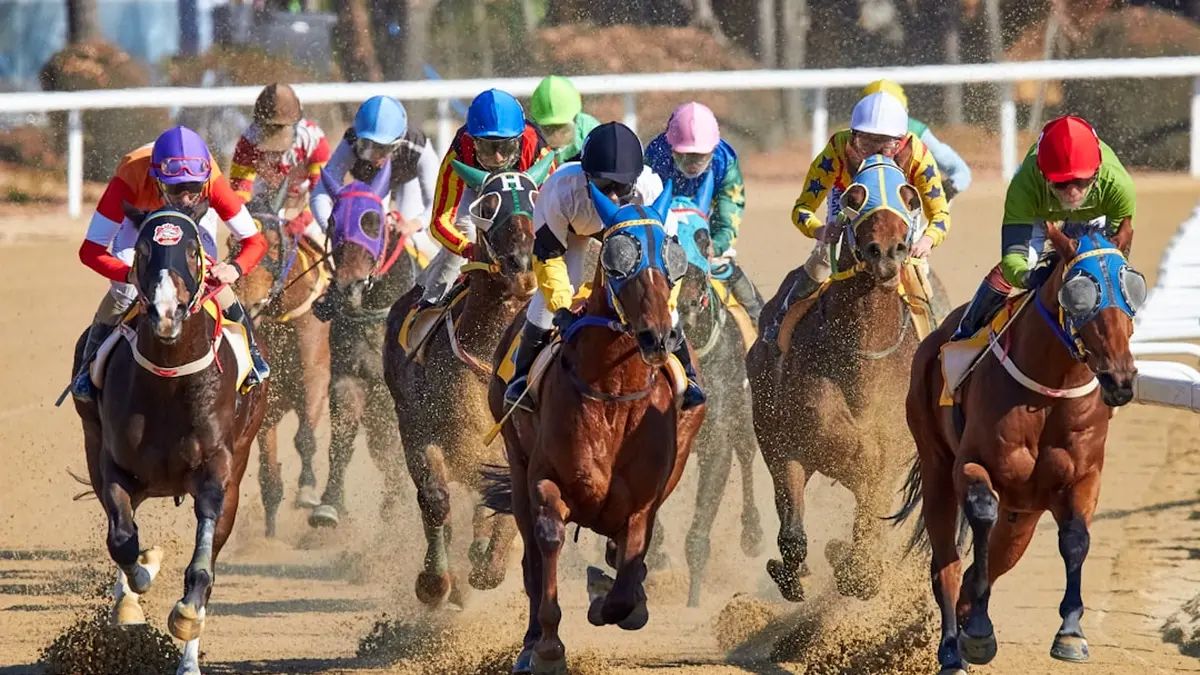
When a broadcaster says a horse is "bred to get the Derby distance," they mean its pedigree, its sire, dam and the generations behind them, leans toward stamina rather than pure speed. A horse's sire is its father, its dam is its mother, and its damsire (also called the broodmare sire) is its mother's father: the three names printed largest on a program's pedigree line, because they are the relatives closest enough to usually show up in how a horse actually runs.
Pedigree is a real signal, used seriously by breeders deciding which stallion to send a mare to, but it is a probability, not a measurement of the horse in front of you. The rest of this piece is where that signal comes from and how far it actually reaches.
The three stallions almost every Thoroughbred traces to
The modern Thoroughbred is a remarkably narrow breed at its root. Nearly every one alive today traces, in an unbroken male line, to one of three stallions imported into England in the late 1600s and early 1700s: the Byerley Turk (1680s), the Darley Arabian (1704) and the Godolphin Arabian (1729). A Y-chromosome study found that 95% of male Thoroughbreds carry the Darley Arabian's direct male line, even though, once you count every line of descent in a full pedigree rather than just the male line, the Godolphin Arabian actually appears more often (13.8% of the time, against 6.5% for the Darley Arabian), a reminder that "foundation sire" describes where a Y chromosome came from, not how much of a horse's overall pedigree traces to that one ancestor.
How to read a pedigree line in a program
Reading a basic pedigree line
-
Find the sire
Printed first, usually in capitals: the horse's father, and the single most-studied influence on its distance range and running style.
-
Find the dam
The horse's mother, listed under or beside the sire.
-
Find the damsire
Printed in parentheses after the dam's name: her own sire, and the pedigree's second most-watched name, since stamina and soundness are widely believed in the breeding industry to pass strongly through the female line.
-
Look one generation further only if you want to
The sire's own sire and the damsire's own sire (the second-generation names) are what a Dosage Index or a deeper pedigree study draws on, covered below.
What recent Derby winners were bred like
The last three Kentucky Derby winners' sire and damsire
| Year | Winner | Sire | Damsire |
|---|---|---|---|
| 2026 | Golden Tempo | Curlin | Bernardini |
| 2025 | Sovereignty | Into Mischief | Bernardini |
| 2024 | Mystik Dan | Goldencents | Colonel John |
No row matches that.
Bernardini, the 2006 Preakness winner, is the damsire of both the 2025 and 2026 Derby winners, a reminder that a single successful broodmare sire can show up across more than one Derby in a short stretch, rather than a sign that any one cross is a formula.
Free to reuse with credit and a link to this page (CC BY 4.0).
The Dosage Index, and why its old rule broke
The best-known attempt to turn pedigree into a number is the Dosage Index, devised by Dr. Steven Roman. It scores a horse's first four generations by identifying particularly influential sires, called chefs-de-race, and classifying each one from Brilliant (pure speed) through Classic to Professional (pure stamina), weighting closer generations more heavily. The result is a ratio of speed points to stamina points: a Dosage Index of 4.00 means roughly four times as much speed influence as stamina influence in the pedigree.
For decades, Roman's retroactive research held up a striking pattern: no Kentucky Derby winner going back to at least 1929 had carried a Dosage Index above 4.00, treated by some handicappers as evidence the Derby's 1 1/4 miles simply ruled out pedigrees that lopsided toward speed.
What pedigree can and cannot say about 1 1/4 miles
Pedigree describes a tendency across many horses, not a certainty about one. A sire whose offspring have generally shown stamina has usually produced plenty of exceptions in both directions, and a single running of the Derby, with one trip, one pace and one track condition, is a small sample against which to test a breeding theory. Pedigree is worth knowing as context, the same way a horse's class level or trainer is, and worth treating with real caution as a reason to expect a specific result.
Comments
No comments yet. Be the first to comment!
Leave a Comment