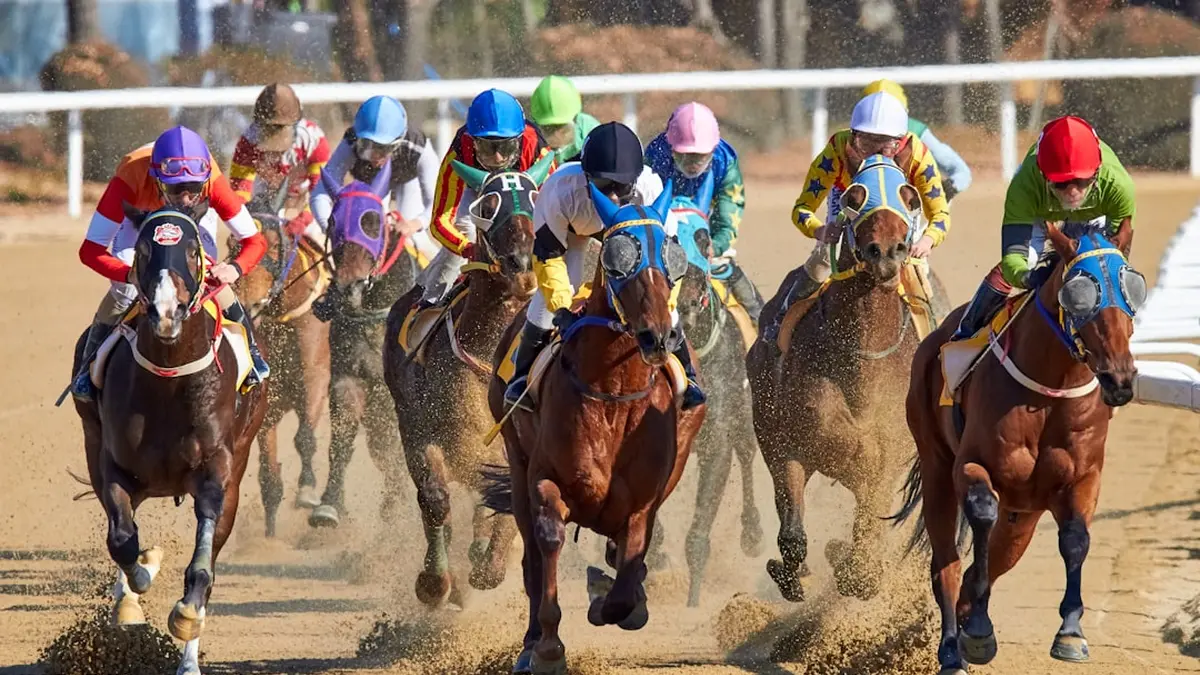
An exacta asks you to pick the first two finishers in exact order. A trifecta asks for the first three, in order. A superfecta asks for the first four, in order, and a Super High-5 for the first five. Each is a single bet on a single, specific order, which is exactly why they pay more than a win bet when they hit: far fewer tickets get it exactly right.
At Churchill Downs, the minimum straight exacta is $2, and $1 if you box or wheel it (below); a straight trifecta is $0.50 a combination, a superfecta $0.10, and a Super High-5 $1. Those minimums, and the takeout on these pools (22% at the September and Fall meets), are Churchill's own and can differ at other tracks.
The four bets, side by side
What each exotic bet requires
| Bet | Picks required, in order | Minimum at Churchill Downs |
|---|---|---|
| Exacta | 1st and 2nd | $2 straight, $1 boxed |
| Trifecta | 1st, 2nd and 3rd | $0.50 |
| Superfecta | 1st through 4th | $0.10 |
| Super High-5 | 1st through 5th | $1 |
Box, key and wheel: four ways to buy more than one order
Betting one specific order straight is cheap but demanding: you have to get every position right. Three other structures let you cover more than one possible order, at a cost that rises with how much you cover.
Box: pick a group of horses and cover every order they could finish in among themselves. A boxed trifecta with 4 horses covers all 24 orders those 4 horses could produce.
Key: pick one horse you believe in and pair it with several others, either fixed in one position ("on top") or free to land anywhere among the top finishers you're covering ("key anywhere"). A key costs less than boxing the same group, because you are only backing one horse to be the one certain finisher.
Wheel / part wheel: pick different sets of horses for each finishing position rather than one group for all of them, useful when you're sure about one position but want several possibilities in another.
A $1 trifecta: box of 4 versus keying one horse over the other 3
4 horses, numbers 2, 5, 7 and 9. A trifecta box of n horses covers n x (n-1) x (n-2) orders; keying one horse on top over k others covers k x (k-1) orders.
| Box all 4 (2-5-7-9, every order) | 4 x 3 x 2 = 24 combinations x $1 = $24 |
|---|---|
| Key horse 2 on top, the other 3 underneath in any order | 3 x 2 = 6 combinations x $1 = $6 |
Boxing costs four times as much as keying here because the box is paying for every horse to have a turn finishing first, not just the one you actually believe will win. If you are confident about the winner and less sure of the order behind it, keying says that with your money; boxing says you aren't sure about any of the three positions.
A $0.10 superfecta box of 6 horses
A superfecta box of n horses covers n x (n-1) x (n-2) x (n-3) orders.
| Box of 6 horses | 6 x 5 x 4 x 3 = 360 combinations |
|---|---|
| Cost at the $0.10 minimum | 360 x $0.10 = $36 |
Adding a fifth and sixth horse to a superfecta box does not add a little to the cost; it multiplies it. A box of 4 is $2.40 at the dime minimum; a box of 6 is $36, fifteen times as much, for two more horses.
What a real payout looks like
The 2026 Kentucky Derby shows the scale exotics can pay when a longshot is involved. Golden Tempo, No. 19 on the program, won at 23-1; the $1 trifecta of 19-1-22 paid $11,250.78, and the $1 superfecta of 19-1-22-12 paid $94,489.95. A ticket covering that exact order would have needed to include all three or four of those horses in the right positions, which in a 20-horse field is a small needle in a very large haystack. Those figures are what pari-mutuel math produces in an unusual result, not a typical return.
Why a bigger box in a 20-horse field is a cost, not a strategy
Because a box's combinations multiply rather than add, covering more of a large field quickly turns into a large bet rather than a safer one. Adding horses to a trifecta box in a 20-horse Derby field to "improve your chances" can mean spending far more without meaningfully improving the odds that your specific group is actually the top three or four finishers; the field itself has 20 horses capable, on paper, of a top-four finish, and no box short of covering most of the field meaningfully narrows that. The honest use of boxing, keying and wheeling is to match the bet's structure and cost to how confident you actually are, horse by horse and position by position, not to buy a feeling of coverage.
Comments
No comments yet. Be the first to comment!
Leave a Comment